Travel textiles · A practical guide
How Silk Travel Pillows Balance Neck Support and Packability
The best travel pillow is a considered compromise: supportive enough to make a cramped seat more restful, compact enough to come along without becoming another burden. Silk travel pillows approach that balance in different ways, from contoured memory-foam neck cushions to compact cushions with silk-blend filling. Understanding their construction, dimensions and care details can help you choose a companion suited to the journey ahead.
Published November 21, 2026
Support and portability, in the same small package
A long journey puts ordinary comforts under a particular kind of pressure. On a plane, headrests and seat angles vary; on a train, a traveller may shift between reading, dozing and looking out of the window. A pillow that works beautifully on a bed can be awkward to carry, while an ultra-compact cushion may not offer the shape or firmness someone wants for rest. The design question is not simply whether a travel pillow feels soft. It is how its form and filling respond to the body, and whether its size and maintenance requirements suit life on the move.
Silk is part of that conversation, but it is important to be precise about where it appears. In travel designs, silk may form the outer shell, contribute to the filling, or be one element in a layered construction. These choices are not interchangeable. A smooth silk cover can offer a pleasant surface against the skin, while a memory-foam core or a silk blend around a supportive core determines much of the pillow’s shape and feel.
That is why it helps to look beyond a product name. Consider the pillow’s purpose, its dimensions, whether it is contoured or cushion-shaped, and how it opens or comes apart for cleaning. These practical details turn the broad idea of a “silk travel pillow” into a more useful question: which construction fits the way you travel?
Two distinct approaches to travel comfort
Travel pillows generally fall into different functional families. A contoured neck pillow is shaped to sit around the neck and offer support when the head might otherwise tip sideways. A compact cushion has a more familiar pillow-like profile and can be placed behind the head, between the body and a seat, or used for a short rest in a hotel or waiting area. Neither form is automatically better; the right choice depends on how and where you expect to use it.
Contoured support with memory foam
Memory foam provides the structure in several contoured travel neck designs. The shape is intended to cradle the neck, while the foam gives the pillow a defined body rather than the looser feel of a lightly filled cushion. A silk shell brings a soft textile surface to the design, but the foam is the element responsible for its supportive profile.
For example, Gingerlily’s [Silk Travel Neck Pillow in Navy](/products/silk-travel-neck-pillow-navy-4611) pairs a contoured shape and memory-foam cushion with a 100% mulberry silk cover listed at 19 momme. It also has a clip closure and removable cover. That combination may appeal to someone who wants a neck-specific shape and a cover that can be taken off for care, rather than a pillow intended primarily as a small general-purpose cushion.
Other listed neck designs use the same broad construction with different details. The Seashells version has a memory-foam core, removable silk cover, clip-button closure and rose-pink piping. The Green & Ivory Stripe neck pillow is also described as using memory foam and a removable cover, with stated dimensions of 12 × 12 × 4 inches. These measurements provide a useful sense of scale, though a traveller should also consider how a contoured pillow sits against their own neck and seat.
A compact cushion with a layered fill
A travel cushion takes a different route. Rather than wrapping around the neck, it offers a small, versatile form that can be positioned according to the traveller’s preference. Some designs use silk filling around a polyester core to balance softness with a more stable cushion shape. In these constructions, the cover and the filling may be different materials, so checking the specification matters.
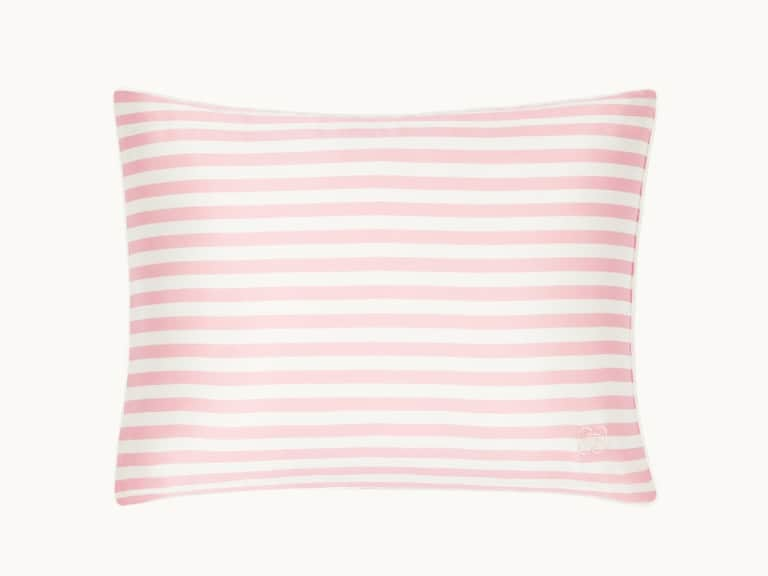
The [Silk Travel Pillow in Pink & Ivory Stripe](/products/silk-travel-pillow-pink-ivory-stripe-4645), for instance, is described as having a filling of 50% pure long-strand mulberry silk around a 50% polyester core. Its cushion casing is 100% cotton sateen at 300 thread count, and a cushion pad is included. The product description also specifies 19-momme mulberry silk for the travel pillow’s silk material. Rather than assuming every surface is silk, read the construction details to understand exactly which components contain which fibres.
This sort of cushion is not a substitute for a contoured neck support if the main need is to limit sideways head movement. Its appeal lies in versatility: it can provide a small, portable cushion for different moments during travel. The ideal use may be a short rest or added softness, rather than a promise of a particular sleeping posture.
How to assess neck support
Support is personal, and no pillow can guarantee that every seat, posture or sleeping position will feel comfortable. A few construction questions can nevertheless make comparison clearer. First, ask whether the pillow is actually shaped for the neck or whether it is a compact cushion. Second, consider the firmness and structure of the filling. Third, look at how the pillow will be used: a window seat, a long-haul flight and a short train journey can present quite different needs.
- Look for a shape that matches the intended use. A contoured neck pillow is designed to sit around the neck; a cushion can be positioned more freely but may not cradle the head in the same way.
- Identify the core, not just the cover. Memory foam, silk blend and polyester can each contribute differently to structure. The cover material alone does not tell you how firm or supportive the pillow will feel.
- Check closure and fit. A clip can help keep a neck pillow in place around the neck or attach it for carrying, depending on its design. Consider whether the closure feels practical for your routine.
- Think about your seat and posture. A pillow that feels comfortable upright may behave differently when you lean against a window or recline. If possible, assess the shape in a position similar to the one in which you expect to rest.
- Keep expectations realistic. A travel pillow can add cushioning and support, but it cannot change seat ergonomics or guarantee uninterrupted sleep.
Neck pillows are often described in terms of alignment, but comfort is not a single measurement. A contoured profile may suit one traveller and feel restrictive to another. If you are sensitive to firmness or shape, pay particular attention to the dimensions and filling rather than choosing solely for the appeal of a fabric or colour.
Packability is more than a measurement
Dimensions are an obvious starting point, but packability also depends on shape, construction and how a pillow travels between uses. A small cushion may slide easily into a bag, while a contoured design might be more comfortable around the neck but occupy a more noticeable amount of space. A removable cover can simplify refreshing the textile, yet the inner cushion still needs a place in your luggage.
Before choosing, ask whether the pillow is meant to be carried by hand, attached to a bag, or packed inside a case. A clip closure can be helpful in transit, but it does not necessarily mean that the pillow compresses. Likewise, a product described as lightweight is not automatically the most compact option; its shape and dimensions remain important.
Gingerlily’s Green & Ivory Stripe Silk Travel Pillow is listed at 12 × 16 inches, while the matching travel neck pillow is listed at 12 × 12 × 4 inches. Those dimensions describe different forms and make direct comparisons more meaningful than a general label such as “travel size.” Think about the available space in your carry-on, the length of the journey and whether the pillow can serve more than one purpose once you arrive.
For a brief commute, a compact cushion may be enough. For a longer flight or train ride, a traveller might prioritise a contour that feels supportive when seated. Some people may prefer to pack a small pillow in checked luggage and carry a neck cushion separately; others will value a single item that is easy to keep within reach. The most elegant solution is the one that fits the itinerary without making the trip feel over-equipped.
Silk covers, cotton casings and blended fillings
Material descriptions can be dense, especially when a travel pillow combines a cover, casing and filling. The simplest way to read them is layer by layer. The outer surface is what touches the face or neck. The casing encloses the filling. The filling provides the pillow’s internal loft or structure. A product may use silk in one or more of these layers, while cotton sateen, memory foam or polyester provides another function.
Mulberry silk is valued for its smooth feel and natural lustre. On a travel pillow, a silk cover can make the surface feel refined against skin, and a removable cover may be convenient to refresh between journeys. Yet a silk outer layer does not mean the entire pillow is made of silk. In the Pink & Ivory Stripe cushion, for example, the description identifies cotton sateen for the casing and a silk-and-polyester blend for the filling. That level of detail matters to anyone comparing feel, weight or care.
Memory foam neck pillows likewise use silk as a covering rather than as the source of the contoured structure. A 19-momme silk shell and foam core perform different roles. The silk contributes the textile finish; the foam forms the cushion. A clear understanding of those roles helps prevent the common assumption that every item described as a silk pillow has the same internal construction.
Silk weight, expressed in momme, is a useful specification when comparing silk fabrics, but it should not be treated as a complete measure of a pillow’s comfort or durability. Shape, stitching, filling and care all contribute. When a travel pillow lists 19 momme, take that as a detail about its silk fabric and assess it alongside the rest of the construction.
Care that travels well
Travel brings a pillow into contact with changing environments, so cleaning and storage deserve as much attention as initial comfort. A removable cover can make routine care more manageable because the textile can be separated from the inner cushion. It is still important to follow the specific care label: the correct method depends on the fabric and construction, and a removable cover does not imply that the foam or cushion pad can be washed in the same way.
For the Pink & Ivory Stripe travel pillow, the available product information describes a silk travel surface and a separate cotton sateen casing around a blended filling, but does not provide a complete wash method for every component. Follow the item’s current care instructions rather than assuming that the whole pillow should be machine washed. For contoured travel neck pillows with removable silk covers, the listed care guidance specifies a delicate machine cycle at no more than 30°C with mild detergent, followed by air drying and a cool iron where appropriate. Always verify the label on the specific item before washing.
Gentle handling is especially important for silk. Avoid high heat, harsh detergents and tumble drying when the care directions advise against them. If a cover is removable, take care not to stretch or snag it while removing or replacing it. Letting it dry fully before packing can help prevent the pillow from being stored damp.
A little preparation can make care easier on the road. Keep the pillow in a clean part of your bag, separate it from toiletries that might leak, and allow it to air after use when practical. If a washable cover is part of your design, pack it with a small laundry bag or a clean pouch so it can be kept apart from worn clothing until you return home.
A simple comparison checklist
When two pillows look equally appealing, a brief checklist can reveal which is more appropriate. Begin with your primary need: neck support, a general cushion, or a surface that feels comfortable against the skin. Then compare the filling and the full dimensions. Finally, consider care and carrying details.
- Purpose: Is it a contoured neck pillow or a small cushion?
- Filling: Does it use memory foam, silk filling, a blended fill, or a supportive core?
- Cover and casing: Which parts are silk, cotton sateen or another material?
- Dimensions: Will its shape fit your carry-on and the seat where you plan to use it?
- Closure: Is there a clip or another feature that suits your preferred way of carrying or positioning it?
- Care: Can the cover be removed, and what do the care instructions say about the cover and inner cushion?
This approach also makes comparisons more grounded. One pillow might win on a contoured shape, another on a compact cushion profile, and another on the convenience of a removable cover. A single “best” choice is less useful than knowing which features matter most for your journey.
Choosing by journey
For a flight or train ride where the priority is supporting the neck while seated, begin with a contoured design and examine the filling, closure and removable-cover details. A memory-foam model such as the Navy Silk Travel Neck Pillow provides a clear example of that format: a shaped profile, foam cushion, silk cover and clip closure. The design is intended for travel, but personal fit remains the deciding factor.
For a journey where flexibility matters more than a neck-specific contour, consider a compact cushion. The Pink & Ivory Stripe Silk Travel Pillow combines silk filling around a polyester core with a cotton sateen casing. Its construction illustrates how a travel pillow can balance a soft textile identity with a more structured centre. Check its size against your luggage and think about how you are likely to position it.
For frequent travel, maintenance may become a defining consideration. A removable cover can be useful when you want to refresh the textile between trips, while clear component-specific care instructions help protect the filling. For occasional journeys, a design that packs simply and serves the intended purpose may be the more sensible choice.
The final balance
A well-chosen silk travel pillow brings together more than softness. It balances a shape suited to the journey, a filling suited to the desired level of structure, and a size that feels reasonable to carry. Silk can add a smooth, breathable textile layer, but the support itself depends on the pillow’s form and core. That distinction is the key to comparing options with confidence.
Look closely at what each design is made of, where the silk sits in the construction, whether the cover comes off and how large the pillow is. Then match those details to the way you travel. A contoured memory-foam neck pillow and a compact silk-blend cushion may both be travel pillows, yet they solve different problems. When support, packability and care are considered together, the choice becomes less about a fashionable promise and more about a thoughtful fit for the hours between departure and arrival.